
How I work
Every organisation has its own history, relationships, constraints, objectives and challenges.
That is why I do not apply ready-made formats. Every intervention starts by listening to the context and is designed together with the people who know and experience the organisation every day.
We start with the challenge, the change we want to make possible, the expected outcomes, the people to involve and the conditions needed for the work to deliver practical results.
On this basis, I design the process, choose methods and tools, and build a sequence of activities to help the group achieve its objective.
The structure provides clear direction, while remaining flexible and adapting as the work with the group unfolds.
Conditions and relationships
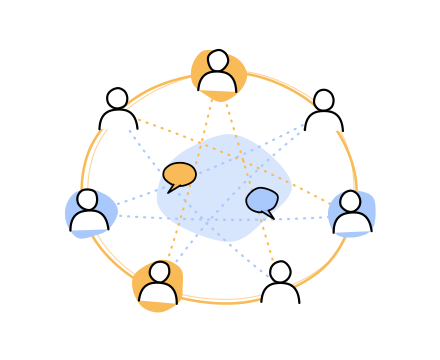
Organisations are living systems, made up not only of structures, roles, processes and procedures, but above all of relationships, conversations, everyday practices, interdependencies and shared meaning.
That is why many problems are not caused solely by people or processes, but by the conditions that enable or hinder particular behaviours.
We cannot ask people to collaborate better if the context continues to reward only individual results. Nor can we expect better decisions if conversations do not allow important information and points of view to surface.
My work is not about directly producing collaboration, trust, listening or responsibility. It is about designing contexts in which these capabilities can develop and gradually become part of how the organisation works.
Facilitation: from understanding to action
When everything speeds up, the natural response is to speed up even more. Sometimes, though, we need to slow down to observe more closely, understand before deciding and interrupt the habitual responses that keep producing the same results. Paradoxically, it is this initial intentional slowing down that then allows the group to act with greater clarity, speed and effectiveness.


1. Observe and focus
We look at what is really happening: facts, dynamics, recurring behaviours, habitual responses, constraints and information that struggles to surface. This makes it possible to look beyond the most visible problem, clarify the question to work on and recognise the conditions that keep the situation going.


2. Widen the field and bring perspectives together
We connect knowledge, information and experience spread across different people, functions and stakeholders. We make interdependencies and implicit assumptions visible, and work through differences without resolving them too quickly, using them to broaden understanding and generate new possibilities.

3. Build choices and solutions
We organise what emerges, define criteria and priorities, and build decisions or solutions grounded in a broader understanding of the situation. Choices are translated into responsibilities, ways of working and practical actions that can guide the work even after the session has ended.

4. Experiment, learn and adapt
We put choices and new behaviours to the test in everyday work. Experience, reflection and feedback help us understand what works, what to change and which lessons to consolidate and turn into shared resources for the organisation.
Experiential training: from delivering content to learning that changes how we act
It is not just about delivering content and offering engaging activities, but about creating the conditions for what is learnt to be understood, tried out and applied in real work situations.


1. Have a concrete experience
We start with an experiential activity that recreates, in a safe setting, dynamics similar to those of everyday work. People act as they usually would, bringing habitual responses and ways of communicating, deciding and collaborating to the surface.


2. Observe and reflect
We pause to look at what happened: what worked, what got in the way of the result, which choices were made and why. Discussing it as a group makes visible what remains hidden while we are acting.

3. Build knowledge
Models and theory help make sense of what was observed and connect it to real work situations. Experience becomes shared knowledge that helps interpret future situations too.

4. Apply it in everyday work
People choose behaviours and tools to try out in their own context and put them to the test in their day-to-day work. Follow-up, practice and feedback consolidate what works and open a new learning cycle.
Clear roles and shared responsibility
The quality of the work also depends on clear roles. When I combine facilitation, training and consultancy, I always make explicit the role of everyone in the room.


The role of the group
The group is at the heart of the work and brings knowledge, experience, points of view and information that no outside observer could hold in the same way. It takes part in the discussion, questions its own assumptions, tries out different possibilities and takes responsibility for the decisions and actions built together.
The role of the leader
The leader makes the challenge explicit, clarifies the desired change and takes part in the process without predetermining its conclusions. They create space for discussion, support experimentation and safeguard over time the conditions needed for decisions, learning and new practices to take root.
My role
When I facilitate, I design and guide the process neutrally, creating the conditions for a structured yet open discussion. Through questions, I bring out what is implicit and help the group connect different perspectives and turn them into useful results.
When I train, I introduce content, models and experiences that help people observe their own behaviour, make sense of what is happening and try out new ways of acting.
When I act as a consultant, I offer my experience and expertise to read the situation, provide ways of interpreting it and guide how the programme develops.
What changes in everyday work?
The programme does not only deliver a result on the challenge at hand. It helps the group develop capabilities and practices it can keep using after our work together.