
ARTICLES · FACILITATION
Facilitation: over thirty years of research, methods and professional practice around the world
An international discipline grounded in decades of research and experimentation, bringing together contributions from different fields to help groups and organisations think, decide and act more effectively.
Facilitation is sometimes presented as a collection of techniques for making meetings more lively. This is a limited view. Behind a facilitated process is an international discipline with older roots, more than thirty years of professional development and a community that continues to study how groups can address complex problems, decisions and change together.
A discipline shaped by different fields
Facilitation did not originate in one place or from one school of thought. It developed over time by bringing together contributions from group and humanistic psychology, adult education, experiential learning, sociology, process consultancy, organisational development, systems thinking and participatory design.
Researchers such as Kurt Lewin, Carl Rogers, Malcolm Knowles, David Kolb and Edgar Schein studied, from different perspectives, the conditions that support learning, participation and change. Other contributions came from work with communities and places, action research, and practices of dialogue and social innovation. There is therefore no single theory of facilitation: there is an interdisciplinary body of knowledge, continually tested in practice.
The shared question is practical: what enables a group of people to make real use of the knowledge, experience and perspectives within it? Bringing them into the same room is not enough. Conditions are needed for important information to emerge, differences to be explored and understanding to become decisions and action.
From research to methods: a toolkit, not a recipe
One approach that has helped structure work on complex problems is Design Thinking, a practical, human-centred approach. It starts by understanding needs and context, then develops solutions to make tangible, test and improve. It is often described in five stages: empathise, define, ideate, prototype and test, but these do not form a rigid sequence. The process is iterative, alternating between opening up to broaden perspectives and possibilities, and converging to select, shape and test what might work.
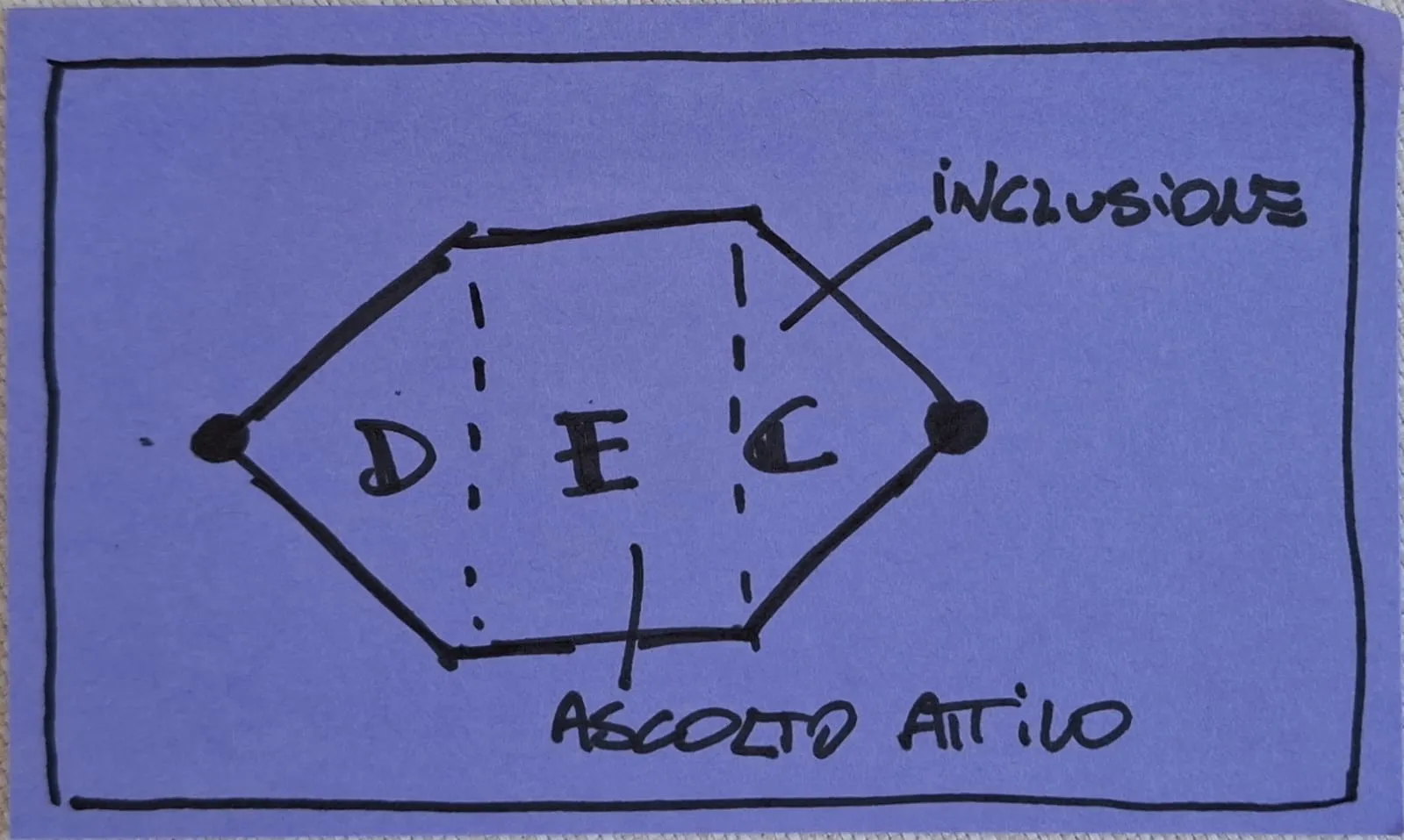
This alternation also underpins the Divergence, Exploration, Convergence model (DEC) which I use to structure facilitation programmes. During divergence, the group broadens the field and surfaces information, ideas and perspectives; in exploration, it connects them, works through differences and disagreement, and builds meaning; in convergence, it narrows the field, clarifies criteria, sets priorities and makes decisions. This is not a theory attributable to one author, but a practical synthesis of established patterns in facilitation and design processes. It also connects with Sam Kaner’s work on the Groan Zone: the stage in which a group needs to stay with complexity and work through differences before converging.
Methods such as Open Space Technology, Future Search, World Café, Technology of Participation, Appreciative Inquiry, Art of Hosting and Liberating Structures operate at another level: they are techniques to select and combine according to the stage, group and purpose. A World Café can support listening to needs and circulating perspectives; Open Space can surface the issues that matter during exploration; a Liberating Structure such as 1-2-4-All can give everyone a voice during ideation, selection or feedback. Other tools help organise information, clarify criteria, set priorities, make decisions or plan action. They are therefore not alternatives to Design Thinking or D.E.C.; they make the different stages practical in the group’s work.
That is why the work starts before the session. The mandate needs to be clarified, the situation understood, expected outputs defined and participants identified. Then a sequence of group activities is designed to guide the group from observation to understanding, from understanding to choices and from choices to action. During the work, the process is adapted to what emerges without losing direction.
What makes facilitation distinctive
Facilitation is not simply chairing a conversation, taking turns to speak or keeping to the agenda. It means designing and guiding the process through which the group works on its content. Participants bring their knowledge of the situation and remain responsible for choices; the facilitator looks after how that knowledge is brought out, connected and turned into useful outcomes.
This distinction between content and process is central. The facilitator should not lead the group towards a predetermined answer, but create the conditions for it to build an answer that is grounded, understandable and workable. Neutrality about the outcome does not mean passivity: it calls for presence, the ability to read group dynamics, address barriers to participation, make tensions and implicit assumptions visible, and keep the work focused on its purpose.
Facilitation does not eliminate conflict or promise that everyone will always agree. Instead, it makes it possible to work through differences and disagreement without losing their informational value. Where consensus is the aim, it does not mean forced unanimity: it grows out of a process in which alternatives have been understood, criteria clarified and implications made visible.
From a widespread practice to a recognised profession
An important step in the professionalisation of facilitation came in 1994, when the International Association of Facilitators (IAF) was founded to provide a home for a growing profession. Since then, the international community has helped define values, ethical principles, competencies and shared routes to professional recognition across different countries, cultures and sectors.
The IAF Core Competencies, first outlined more than twenty years ago and updated over time, show the complexity of the role. They cover building a collaborative relationship with the client; designing appropriate processes; creating a participatory and inclusive environment; guiding the group towards useful outcomes; keeping professional knowledge up to date; and demonstrating integrity, self-awareness and the ability to minimise one’s influence on the group’s content and decisions.
These standards also help explain why facilitation is not a single activity or simply a matter of the facilitator’s charisma. It is a practice requiring theoretical preparation, experience, reflection on one’s own work, command of different methods and the ability to make responsible choices in real time.
Why it matters particularly today
In today’s organisations, the knowledge needed to address a challenge is often spread across different people, functions and stakeholders. No one has the whole picture alone. At the same time, speed, interdependencies and uncertainty push us to accelerate just when we need to observe more carefully, connect information and question our first interpretations.
Facilitation works in this space. It can help a group clarify a complex problem, build a shared direction, make decisions, set priorities and responsibilities, design change or learn from experience. But its value is not limited to the output produced during a workshop. A well-designed process also develops collective capabilities: listening, making assumptions explicit, working with differences, building meaning, deciding and taking responsibility together.
This idea also shapes how I work. I do not start with a catalogue of techniques, but with the real situation: the challenge, the expected outcome, the people who hold different parts of the knowledge and the conditions that currently make it hard to use that knowledge together. The method comes afterwards and serves the process, not the other way round.
Facilitation, ultimately, is not about making complexity simple. It is about making it possible to work through it together. Not taking the group’s place, but helping it see what no one can see alone and turn that understanding into new possibilities for action.
Sources
- International Association of Facilitators (IAF), ‘Discover the IAF’ and ‘IAF Core Competencies – Release 2021’: https://iaf-world.org/discover-the-iaf/
- LOCI – Scuola Superiore di Facilitazione: https://www.loci.it/
- Pino De Sario, ‘Storia della facilitazione’: https://www.pinodesario.it/storia-della-facilitazione/
- Selected key references: Kurt Lewin, ‘Field Theory in Social Science’, Harper & Brothers, 1951; Carl R. Rogers, ‘On Becoming a Person’, Houghton Mifflin, 1961; Malcolm S. Knowles, ‘The Adult Learner: A Neglected Species’, Gulf Publishing, 1973; David A. Kolb, ‘Experiential Learning: Experience as the Source of Learning and Development’, Prentice Hall, 1984; Edgar H. Schein, ‘Process Consultation Revisited: Building the Helping Relationship’, Addison-Wesley, 1999.
- Osservatori Digital Innovation, School of Management, Politecnico di Milano, ‘Design Thinking: cos’è e perché è fondamentale per l’innovazione’: https://www.osservatori.net/blog/design-thinking/design-thinking-significato-importanza/
- Sam Kaner et al., ‘Facilitator’s Guide to Participatory Decision-Making’, third edition, Jossey-Bass/Wiley, 2014.
Would you like to bring this reflection into your context?
If this article has helped you recognise a dynamic in your organisation, we can explore it together and work out how to turn the reflection into a practical next step.