

ARTICLES · LEARNING
Experiential learning: from delivering content to learning that changes how we act
An approach grounded in decades of research into adult learning, bringing experience, reflection, knowledge and experimentation together to develop skills that can be applied in real work situations.
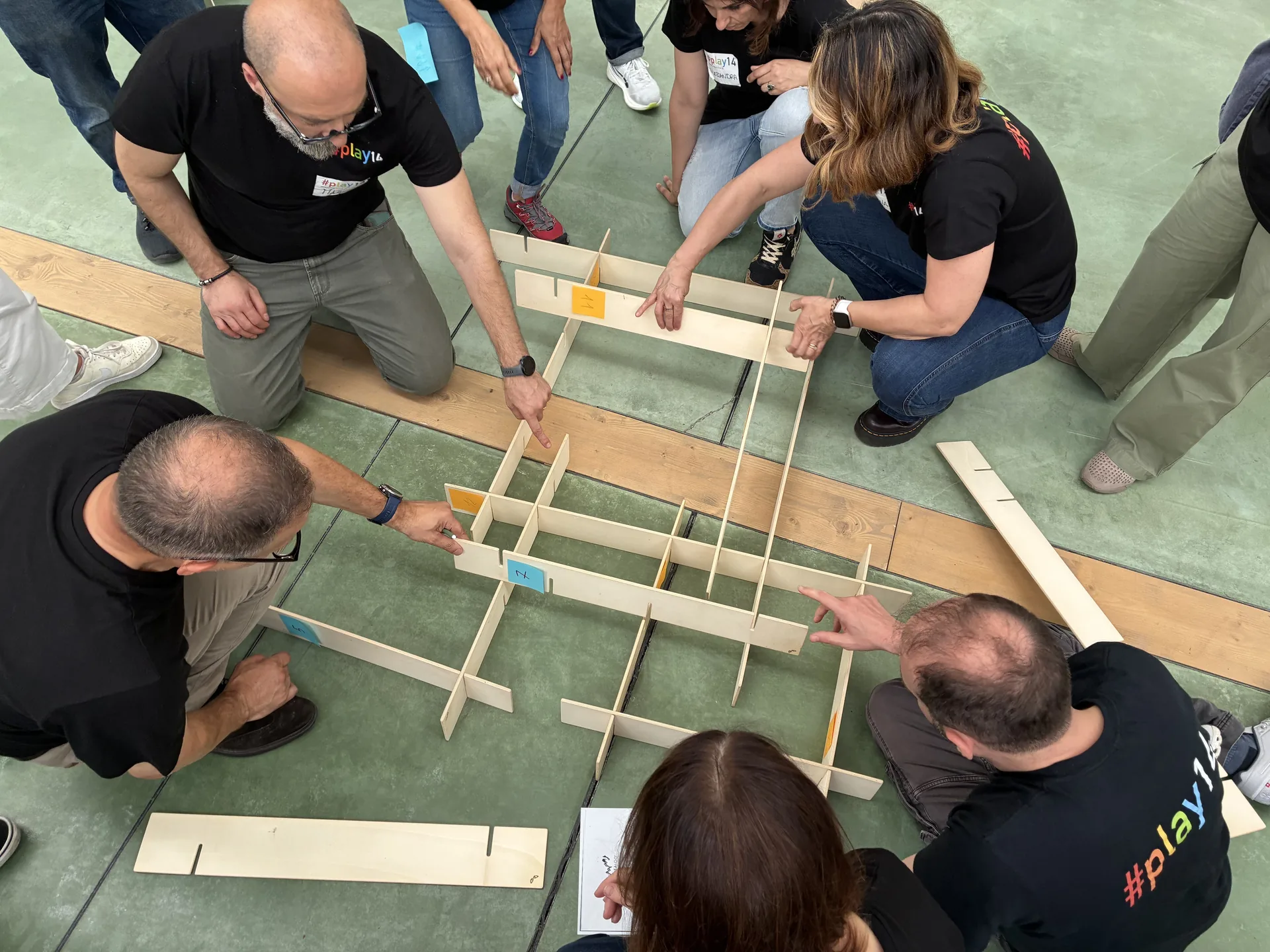
Experiential learning is sometimes presented as a set of engaging activities, simulations, games or exercises that make a course more dynamic. This is a limited view. Giving people an experience does not, in itself, create learning. A well-designed experiential programme draws on a body of research into adult education, behaviour change and how we turn what we experience into new knowledge and capabilities. Above all, it involves an intentional process: start with experience, observe it, make sense of it, connect it to useful models and try out different ways of acting. The difference, then, is not simply about making people more active during a course. It lies in moving from delivering content to learning that can change how we interpret situations, make decisions and behave in practice.
A history shaped around experience and reflection
This shift is not a recent trend or the product of a single school of thought. Throughout the twentieth century, researchers from different fields helped challenge the idea of learning as simply receiving information.
As early as 1938, in Experience and Education, John Dewey put experience at the centre of education, while making a point that remains crucial today: not every experience is automatically educational. Its value depends on the quality of the process and its potential to support development and future experience. In the years that followed, Kurt Lewin connected research, action, group dynamics and change, contributing to a view of learning as a process in which action, observation and review inform one another.
Carl Rogers focused attention on the relational conditions that make meaningful learning possible and on the role of someone who does not simply teach, but facilitates the process. Malcolm Knowles showed how important prior experience, autonomy, motivation and the practical relevance of learning are for adults. Jack Mezirow added the value of critical reflection: learning can also mean questioning the beliefs and perspectives through which we interpret reality.
In 1984, David Kolb brought many of these contributions together in a model that has had a major influence on experiential learning: learning as a continuous cycle through concrete experience, reflective observation, abstract conceptualisation and active experimentation.
This trajectory marks a profound shift: learners are no longer seen as recipients of ready-made answers, but as people who bring experience, knowledge, interpretations and habitual responses, and who need to take part in shaping their own learning.
Why knowledge is not enough: System 1, System 2 and cognitive programmes
Transferring content remains important when people need to acquire information, procedures or technical knowledge. It is not enough, however, when the aim is to develop a behavioural skill.
We may know a great deal about listening, communication, leadership or conflict management and still react in familiar ways in real situations. Knowing what would be helpful does not mean being able to do it under pressure, amid strong emotions, urgency or organisational constraints.
Daniel Kahneman’s distinction between System 1 and System 2 helps explain this gap. System 1 works quickly, intuitively and automatically. System 2 requires attention, intention and greater cognitive effort. They are not two separate anatomical areas, but two different ways of thinking.
Much of our everyday activity is handled by System 1. That is not a problem in itself: habitual responses let us act quickly without analysing every possible alternative each time. Difficulties arise when an automatic behaviour produces ineffective results and keeps recurring, even though we know other approaches in theory.
In Soft Skills: istruzioni per l’uso, Luigi Mengato applies the distinction between System 1 and System 2 to the development of behavioural skills and introduces the idea of ‘cognitive programmes’. These programmes are knowledge structures (models, principles, criteria and frames of reference) that help us interpret a situation and consciously plan an alternative behaviour.
Knowing a model for giving feedback, for example, does not guarantee that we can use it in a difficult conversation. A cognitive programme becomes useful when it helps us interrupt an automatic response, at least briefly, notice what is happening, interpret the situation and choose a different course of action.
The development process can be described in four steps: recognise when we are acting automatically or deliberately; assess the effects of our behaviour in terms of effectiveness rather than abstract correctness; engage System 2 and use cognitive programmes to plan an alternative; then practise and repeat the new behaviour until it becomes more accessible and spontaneous.
The aim is not to think slowly in every situation, but to expand the range of effective behaviours we can use automatically. A skill takes root when something that initially required attention, intention and effort gradually becomes more natural.
Experience alone is not enough
In experiential learning, experience is the starting point, not the end result. An exercise can create engagement, energy or awareness, but without reflection it may remain an interesting, isolated episode.
Through observation and discussion, people can recognise what happened, which behaviours they used, what effects they had and which patterns shaped their decisions. Debriefing is therefore not an extra comment at the end of an activity: it is where experience becomes material for learning.
Theory and models can also be introduced afterwards to name what has emerged, organise observations and offer new ways of looking at it. The cycle is completed when people plan an alternative behaviour and have the opportunity to try it out.
Experience, reflection, conceptualisation and application are therefore not separate stages, but parts of a process in which each supports the others.
Designing experiences, not simply activities
Designing an experiential programme does not mean starting with a technique, a game or a simulation. It means starting with the real situation: Which behaviours keep recurring? What results do they produce? Which capability needs to develop? What should happen differently in everyday work?
Only once these questions are clear can we choose the most useful experience: a simulation, role-play, case study, metaphor-based activity, structured conversation or experiment directly related to the professional context.
The value of an activity does not depend on how original, spectacular or entertaining it is. It depends on its fit with the objective, the quality of the reflection it prompts and whether what happens during training can be connected to real situations.
Experience is therefore not a device for making training more enjoyable: it is deliberately designed to make behaviours, interpretations and consequences observable.
Learning eXperience’s 4C model
I work with Learning eXperience and am part of its trainer community. The 4C model, Knowledge, Capability, Competence and Convictions, was developed by Learning eXperience and is one of the frameworks used to design programmes.
Knowledge is what we know: information, concepts, models and principles. Capability is what we can do through action. Competence emerges from combining knowledge and capability, and is expressed through observable behaviour in specific situations. Convictions influence how we interpret what happens, which possibilities we can see and which actions we consider feasible.
The model shows why transferring knowledge alone is not enough. We may know a technique but be unable to apply it; we may have a capability but not use it because a belief leads us to interpret the situation in a particular way.
Developing a competence means working at the same time on what a person knows, what they can do and the convictions that guide their choices.
The trainer as a facilitator of learning
This perspective also changes the trainer’s role. They are not just someone with content to present, but someone who designs and facilitates a process in which participants can observe what they do, exchange views, make meaning and try different possibilities.
This calls for conditions that support participation and trust, questions that encourage reflection, sharing what emerges without taking the place of participants, and continually connecting the learning to their reality.
Facilitating learning does not mean abandoning content or leaving the process without direction. It means using knowledge, methods and experience to help people become more able to understand and shape their own actions.
From the classroom to real work situations
The most delicate transition happens when people return to their professional context. In the classroom, they may have understood a model, recognised a habitual response and tried a different one. In everyday work, however, they will encounter urgency, pressure, established habits, relationships and organisational conditions that tend to reactivate previous behaviours.
That is why a single session on soft skills, even when well designed and engaging, is unlikely to create lasting change. Developing behavioural skills takes a programme: repeated opportunities to experiment, reflect, receive feedback and apply learning in real situations.
Training can start the process, offer cognitive programmes, make habitual responses visible and allow people to try alternatives. For a new behaviour to take root, however, people need continuity, deliberate practice and the opportunity to observe its effects over time.
The organisational context also plays a decisive role. If the behaviours practised during training have no room, recognition or support in working life, a return to previous habits is very likely. Developing soft skills is therefore not only an individual matter: it requires organisational conditions that support change.
In my work, I start from the real situation and design programmes in which experience, reflection, knowledge and experimentation can reinforce one another over time. The aim is not simply to understand something during a session, but to apply it in everyday relationships, decisions and actions.
Experiential learning, ultimately, is not simply about creating a memorable experience. It is about creating the conditions for that experience to become learning, and for learning to change how we act over time.
Sources
- John Dewey, Experience and Education, 1938.
- Kurt Lewin, Action Research and Minority Problems, 1946.
- Carl Rogers, Freedom to Learn, 1969.
- Malcolm Knowles, The Adult Learner, 1973.
- Jack Mezirow, Perspective Transformation, 1978.
- David Kolb, Experiential Learning: Experience as the Source of Learning and Development, 1984.
- Daniel Kahneman, Thinking, Fast and Slow, 2011.
- Luigi Mengato, Soft Skills: istruzioni per l’uso, 2026.
- Learning eXperience, LX Approach.
Would you like to bring this reflection into your context?
If this article has helped you recognise a dynamic in your organisation, we can explore it together and work out how to turn the reflection into a practical next step.