
GUEST LECTURE · UNIVERSITY OF MILANO-BICOCCA
When teamwork gets stuck
Using Sam Kaner’s Diamond to explore group work, from the university classroom to the workplace.
ROLE
Session design and facilitation
PARTICIPANTS
30 students
COURSE
International Business Organisation
DATE AND LOCATION
16 November 2026, Milan
Groups in the classroom and in organisations
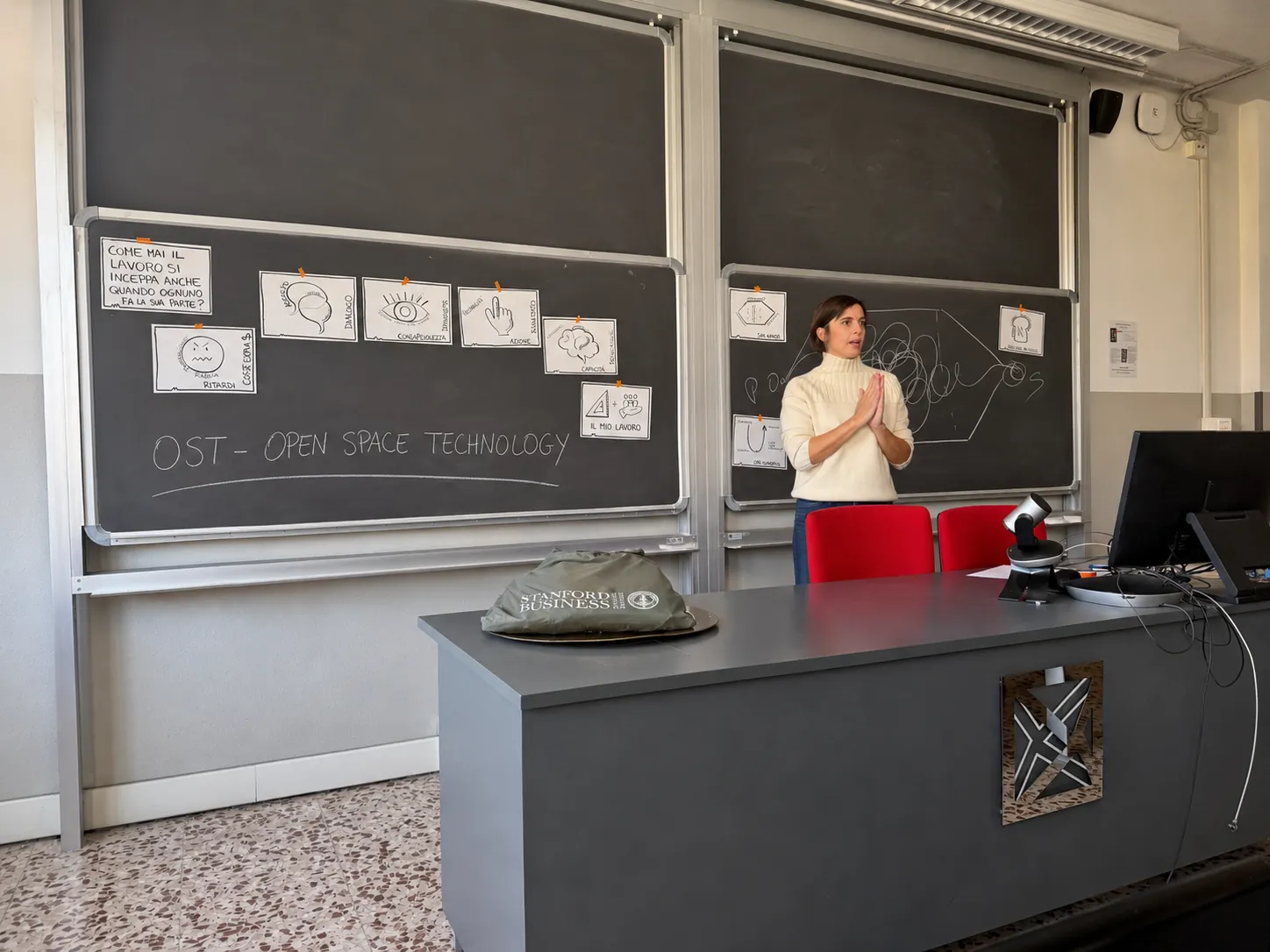
In Professor Pietro Catania’s International Business Organisation course, the classroom itself becomes a temporary organisation. Working alongside their classmates, students can observe how responsibilities are shared, how decisions are made and how people collaborate across different perspectives.
Why does teamwork stall even when everyone is doing their part? To explain what I do as a consultant and facilitator, I asked each student to think back to a group project at university. At first, everything seemed straightforward. Then the work began and something stalled. What had happened? How had people responded? What emotions had surfaced in the group?
The same can happen in a company. Delays, rising costs and commitments to clients all add pressure to find a solution.
Using Sam Kaner’s Diamond
I sketched Sam Kaner’s Diamond to show how I support groups to solve problems and make decisions. We start by looking at how the situation is understood, then open up the discussion to bring different perspectives to the surface. Once the group has enough information, it can move towards convergence and decide how to proceed. It sounds straightforward in theory. What happens in practice?
The pressure to act
In the case I shared, orders were getting stuck, costs kept rising and the company’s partners had to step in to get the work moving again. By the next project, the same bottleneck had returned, bringing anger and frustration with it.
Under that pressure, it was tempting to jump straight into action. But our first task was to define the problem together and understand what was driving the delays and extra costs.
Listening, honesty and courage
The first challenge was deciding who needed to be involved. People can easily be left out because they have little influence in the hierarchy, or dismissed with a “they only ever complain”. Yet, to understand how the process really worked, we needed to hear from those who handled its less visible steps every day.
Speaking up in front of a manager about a procedure that causes difficulties takes courage. That is why I start by agreeing some ground rules with the group: we listen without judgement and ask questions to understand how the work gets done. The focus is on how the system operates, not on judging individuals. What happens when an order moves from one function to another? What information is passed on, and what else is needed to keep things moving?
Seeing the process through different eyes
During the work with the company, I asked everyone to draw the process from their own point of view. When we laid the drawings side by side, the moment could be summed up like this: “Houston, we have a problem. We thought there was only one process.”
This is the widest point of the Diamond. When perspectives differ, it takes courage to stay in the conversation. What do you need in order to move forward? How does this decision affect your work? Bringing the answers together helped the group define the problem and spot possible ways forward that no single function could see on its own.
From possibilities to decisions
The map brought around 20 issues to light. Taking into account the effects on other functions, the group chose where to start and developed an action plan. Who will do what, by when, and how will we check whether it works?
My role and the step back
I start by talking with the person who contacts me. Together, we clarify what is needed, agree on the objective and decide who should be involved. I then design the process and its activities.
When the group comes together, I put the question to them and step back. I value the moment when people stop answering me and start asking one another questions. That is when my role changes. I call it holding the space: I stay present without steering towards a particular solution, let the group choose its direction and step in when someone is struggling to speak or the conversation loses its thread.
There is another step back, too: the one I take as the group grows more autonomous. This is the most rewarding part of my work. The action plan belongs to the group from the outset. Its autonomy becomes visible when the next difficulty arises and people can recognise it, talk it through and decide together how to respond.
“Have you ever turned down a project?”
The question came at the end of my account, after I had spoken about kindness and respect, slowing down before speeding up, and making room for the complexity of different perspectives. What if you find yourself in an organisation where the conditions for working in this way are missing? I was glad the conversation went there: choosing the conditions you are willing to work in is part of the job, too.
From there, we explored how to make space for dialogue when a conversation becomes difficult. If the manager is at the table and everyone else falls silent, how do you draw out their views? How do you create space for dialogue when everyone is in a hurry to find a solution? And what if the group does not reach its agreed objective?
How do you work with conflict when it arises? How do the group’s emotions affect you? We went on to talk about how I prepare to stay present in conflict. Understanding my own reactions as tension rises helps me decide when and how to support the group.
The next question came naturally: “What experiences brought you to this work?” I talked about the varied path I have taken, with its personal and professional turning points. As a woman and a professional, I am still finding my way. The world around us changes, and we change with it. I encouraged the students to stay curious and open to what each new experience might teach them, including about themselves.
Their questions gave me the chance to talk about aspects of the work that are hard to see from the outside. I wanted to leave them with a question to carry into their next group project that gets stuck:
What do we need to understand together before deciding how to move forward?
When can facilitation help?
Some groups struggle to reach a decision; different functions see the same problem in very different ways; and some teams need to rethink how they work together. In my case studies, I describe where we started, how I supported the group and what the people involved were able to change.